

Ready to make smarter hiring decisions? Call us at (703) 864-2599 for a free consultation on AI solutions for your business.
You’re staring at another stack of resumes, wondering if you should hire that new customer service rep or if there’s a better way. Meanwhile, your current team is drowning in repetitive tasks, and you’re bleeding money on overtime just to keep up with basic operations.
Here’s the thing: the choice between AI agents and human employees isn’t really a choice anymore: it’s about finding the right mix. Smart small business owners in 2025 are discovering that combining both strategically can slash costs by up to 70% while actually improving service quality.
Let’s break down exactly when you should choose AI, when you need humans, and how to blend both for maximum impact.
What Exactly Are AI Agents?
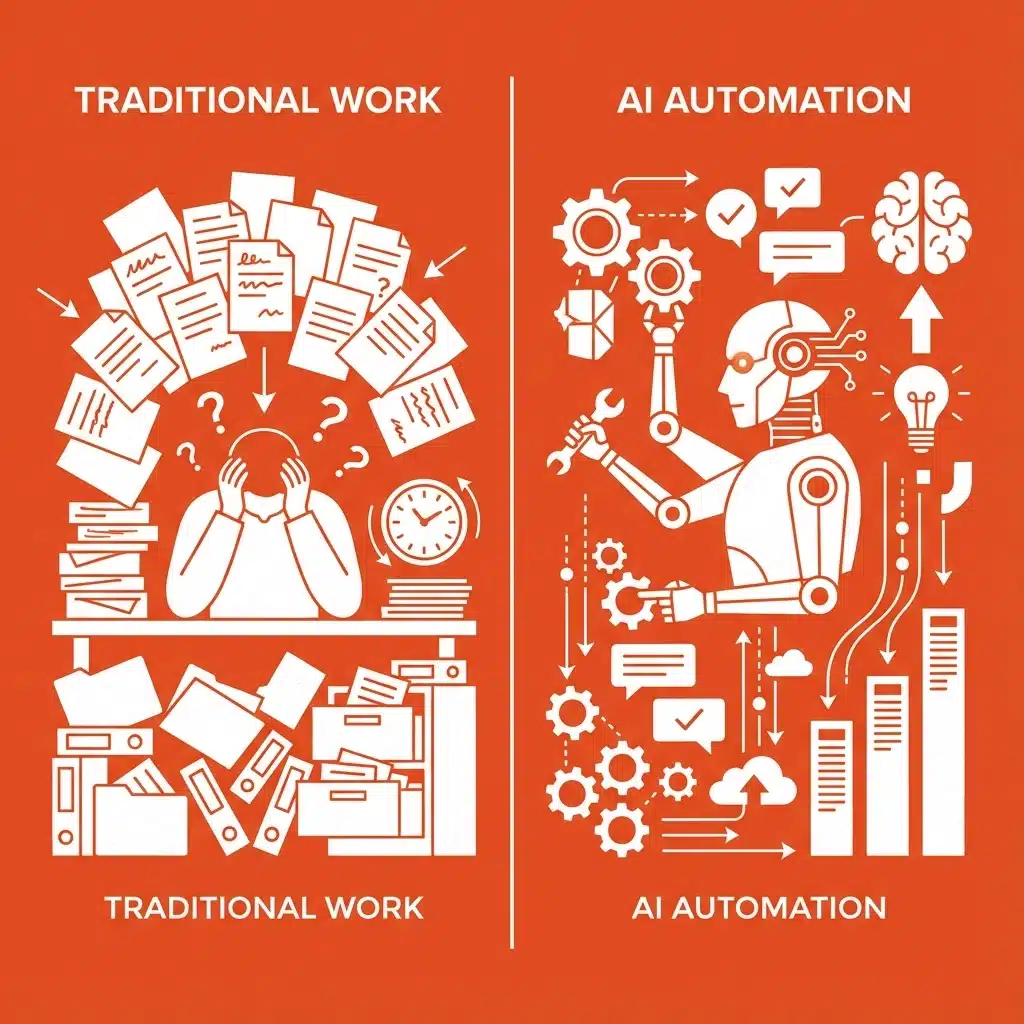
Think of AI agents as digital employees that never sleep, never call in sick, and work for about $2 per hour instead of $25. They’re software programs that can handle conversations, process orders, manage schedules, and complete routine tasks just like a human would: but faster and more consistently.
Unlike basic chatbots that spit out canned responses, modern AI agents can actually think through problems, access your systems, and make decisions. They can check inventory, process refunds, schedule appointments, and even handle complex customer complaints by following decision trees you set up.
The Case for AI Agents: When Robots Win
Cost Savings That’ll Shock You
The numbers don’t lie. A full-time customer service employee costs you roughly $50,000 annually when you factor in salary, benefits, taxes, and training. An AI agent handling the same workload? About $2,000 per year. That’s a 96% cost reduction.
Sarah from Atlanta learned this the hard way. Her boutique marketing agency was spending $120,000 annually on two customer service reps who mostly answered the same 20 questions over and over. After implementing AI agents, she cut those costs to $15,000 while improving response times from 4 hours to 4 minutes.
24/7 Availability Without Overtime
Your customers don’t stop having problems at 5 PM. AI agents work around the clock, handling late-night order issues, weekend inquiries, and holiday emergencies without charging you a penny extra. No more losing sales because someone called after hours.
Perfect Consistency Every Time
Human employees have bad days. They get tired, cranky, or distracted. AI agents deliver the exact same quality interaction whether it’s their first customer of the day or their thousandth. They follow your scripts perfectly, never forget to ask for reviews, and always upsell when appropriate.
Instant Scalability
Black Friday traffic spike? No problem. An AI agent can handle 1,000 simultaneous conversations as easily as 10. Try doing that with human staff without bankrupting yourself on temporary hiring and training.
When You Still Need Humans: The Irreplaceable Elements
Complex Problem-Solving and Creativity
When Mrs. Johnson calls because her custom wedding cake order got mixed up three days before her daughter’s wedding, you need human empathy, creative solutions, and the ability to think outside the box. AI agents excel at routine tasks but struggle with unique situations requiring judgment calls.
Building Real Relationships
People buy from people they trust. Your top salesperson who remembers that John’s daughter just started college and asks about it during calls? That relationship-building creates customer loyalty that no AI can replicate.
Strategic Decision Making
AI agents can tell you what happened, but they can’t decide what you should do about it. Strategic planning, market analysis, and business development still require human intelligence and experience.

The Real-World Comparison: AI vs Human Performance
Let’s look at actual performance metrics from small businesses that track both:
Speed and Efficiency:
- AI agents respond in under 30 seconds, humans average 3-5 minutes
- AI handles 85% of routine inquiries without escalation
- Processing time for standard requests: AI completes in 2 minutes, humans need 8-12 minutes
Cost Breakdown (Annual):
- AI Agent: $2,000 (software) + $3,000 (setup/training) = $5,000 total
- Human Employee: $35,000 (salary) + $15,000 (benefits/taxes) + $5,000 (training/equipment) = $55,000 total
Quality Metrics:
- AI consistency rating: 98% (same quality every interaction)
- Human satisfaction for complex issues: 89% (when properly escalated)
- Customer preference: 67% prefer AI for simple tasks, 78% prefer humans for complex issues
The Winning Strategy: Hybrid Teams
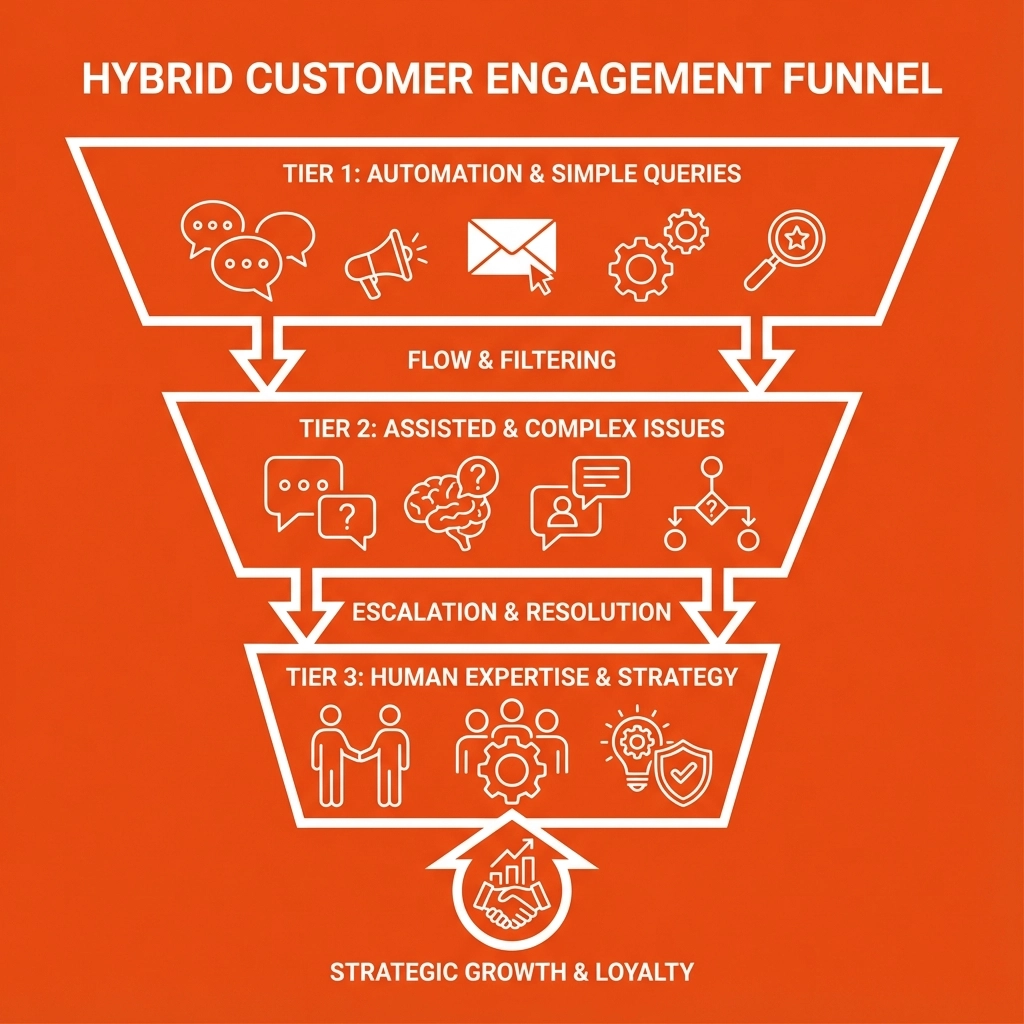
The most successful small businesses use a tiered approach:
Tier 1: AI Handles the Basics (80% of inquiries)
- Order status checks
- Basic product questions
- Appointment scheduling
- Password resets
- Simple troubleshooting
Tier 2: Smooth Human Handoffs (15% of inquiries)
- Complex technical issues
- Complaints requiring empathy
- Custom orders or special requests
- Billing disputes
Tier 3: Human Expertise (5% of inquiries)
- Strategic account management
- Major problem resolution
- Sales negotiations
- Relationship building
How to Decide What’s Right for Your Business
Choose AI Agents First If:
- You’re handling high volumes of repetitive inquiries
- Your team spends more than 30% of their time on routine tasks
- You need 24/7 coverage but can’t afford night shifts
- Cash flow is tight and you need immediate cost savings
- Your customers mostly need quick, straightforward answers
Stick with Humans If:
- Your business depends heavily on personal relationships
- You handle mostly unique, complex situations
- Regulatory compliance requires human oversight
- Your competitive advantage comes from personalized service
- You’re in a creative or strategic industry
Go Hybrid When:
- You want the best of both worlds (which is usually the answer)
- Your business has both routine and complex needs
- You want to free up human talent for higher-value work
- You’re growth-focused and need scalable solutions
Real Success Stories from Small Businesses
Mike’s HVAC Company (Phoenix, AZ):
Mike was drowning in service calls and couldn’t afford another full-time dispatcher. He implemented an AI agent for appointment scheduling and basic troubleshooting. Result: 40% reduction in phone time for his human staff, 24/7 emergency scheduling, and $45,000 annual savings.
Jennifer’s E-commerce Store:
Jennifer’s online pet supply business was losing customers due to slow response times. Her AI agent now handles order tracking, return processing, and basic product questions, while her human team focuses on complex customer relationships. Customer satisfaction increased 25% while support costs dropped 60%.
Getting Started: Your Action Plan
Week 1: Audit Your Current Workload
Track what your team spends time on for one week. Identify repetitive tasks that follow predictable patterns: these are perfect AI candidates.
Week 2: Start Small
Pick one routine function like appointment scheduling or FAQ responses. Test with an AI agent while keeping human backup available.
Week 3: Monitor and Adjust
Watch customer satisfaction scores and employee feedback. Fine-tune the AI’s responses and handoff procedures.
Month 2+: Expand Gradually
Add more functions as you get comfortable. Always maintain the human safety net for complex issues.

The bottom line? You don’t have to choose sides in the AI vs human debate. The smartest small business owners are building hybrid teams that leverage both AI efficiency and human expertise. Start with AI for your routine tasks, keep humans for relationship building and complex problem-solving, and watch your costs drop while service quality soars.
Ready to explore AI solutions for your business? Call (555) 123-4567 or schedule a free consultation to discover which tasks in your business are perfect AI candidates. Let’s build your hybrid team strategy together.

