A customer searching for your business may never start on your website.
They may ask Google for the best HVAC company nearby. They may ask ChatGPT which dentist serves a certain neighborhood. They may use Perplexity to compare local contractors before making a call.
Those tools look for signals they can trust. Google Business Profile data, review text, ratings, service details, business websites, directories, and third-party mentions all help shape the answer.
Your reviews sit inside that data.
They tell AI what your business does, where you serve customers, what people value, and whether the experience is worth recommending. That doesn’t mean every review is copied into a giant AI training set. Google AI Overviews, ChatGPT Search, and Perplexity work in different ways. Still, they all depend on public information to understand businesses and answer customer questions.
That makes your review profile more than a reputation tool. It’s part of your business’s AI-readable identity.
Reviews give AI the language customers actually use
Your website may say “residential plumbing services.” A customer may write, “They replaced our leaking water heater the same day in Fairfax.”
The second description carries more useful detail.
A real review can reveal:
The exact service a customer purchased
The city, neighborhood, or service area involved
The problem your business solved
The speed of the response
The quality of the work
The traits customers associate with your team
The reasons someone would choose you over a competitor
AI systems use language like this to connect businesses with specific searches. A review that mentions “same-day emergency furnace repair” gives more context than one that only says “Great service.”
That doesn’t mean you should write reviews for customers. Google prohibits scripted or manipulated review content. Your job is to create a good experience, ask every customer for honest feedback, and make the process simple.
Try this request:
“Thanks for choosing us. Would you share an honest review of your experience on Google? Your feedback helps other customers understand what we do.”
No five-star request. No suggested keywords. No pressure.
For local businesses, Google also uses information from Business Profiles, public web pages, customer contributions, photos, and reviews. Its local listing documentation explains that review summaries can be generated from customer feedback about a place.
A customer searching for “best family dentist near Arlington” may see a summary of businesses before visiting any website. The system may consider review sentiment, business details, location, services, and the freshness of the information available.
You don’t control which business Google recommends. You can control the quality of the information Google has available.
Start with a quick profile check:
Is your primary category accurate?
Are your services listed clearly?
Are your hours current?
Does your description explain who you serve?
Does your phone number match your website?
Do your reviews mention your main services naturally?
Have you responded to recent feedback?
Fix one weak section today. A complete profile gives search systems a clearer picture of your business.
ChatGPT and Perplexity read beyond your website
Google isn’t the only place where customers ask for recommendations.
ChatGPT Search can search the web and show citations. Its answers may draw from business websites, directories, review platforms, and other public sources.
Perplexity also provides citations to the pages it uses. The sources can vary by query, location, and business category, but the lesson is simple: AI search needs a consistent trail of trustworthy information.
Your Google reviews may be part of that trail directly or indirectly. They can reinforce the details found across your website, listings, and other review platforms.
That’s why consistency matters.
Check your business name, address, phone number, hours, and service descriptions across:
Google Business Profile
Your website
Bing Places
Yelp
Apple Business Connect
Industry-specific directories
Local chamber or association listings
If one listing says you serve Alexandria and another says you only serve Washington, D.C., automated systems have to decide which one is correct. Remove the guesswork.
Detailed reviews beat empty praise
“Great company. Highly recommend.”
That review is positive, but it gives future customers and AI systems very little to work with.
A useful review explains what happened. It might mention the original problem, the service performed, the location, the outcome, or an experience that stood out.
You can encourage useful feedback without telling customers what to write. Ask open questions during normal follow-up conversations:
What problem were we able to solve?
Was there anything about the process that stood out?
Which part of the service helped you most?
Would you recommend us to someone with a similar need?
Use the answers to improve the customer experience. Don’t turn them into a script.
If customers repeatedly praise your quick arrival, clear pricing, or clean work area, those themes become part of your public business identity. If they repeatedly mention missed calls or confusing invoices, fix the process instead of trying to bury the comments.
Your review profile should reflect the business you want AI to understand.
Fresh reviews show that the business is active
A profile with hundreds of reviews from five years ago may look less useful than one with a steady stream of recent feedback.
Fresh reviews help customers see that the business still serves the area and that its current team is creating current experiences. They also give search systems newer information to evaluate.
Build review requests into your normal workflow:
Choose the point when a customer has received the clearest value.
Send a neutral request by text or email.
Include a direct link to your Google review form.
Ask every customer using the same basic process.
Track how many requests were sent and how many reviews arrived.
Read the feedback each week.
Avoid review gating. Don’t send happy customers to Google while pushing unhappy customers into a private form. Google’s review policy allows businesses to ask for genuine feedback, but it prohibits incentives, pressure, fake reviews, and selective solicitation.
A steady, honest process will serve you better than a short burst of questionable reviews.
Your replies become part of the public record
A review response is written for more than the person who left the review. Future customers read it too. Search systems can read it as part of the page’s public information.
Keep replies short, specific, and calm.
For a positive review:
“Thank you for sharing this feedback. We’re glad our team could complete the water heater installation quickly and explain the next steps clearly.”
For a negative review:
“We’re sorry the visit didn’t meet expectations. We’d like to review what happened and make this right. Please call us at 703-864-2599 so our team can look into it.”
Don’t argue. Don’t reveal private customer information. Don’t paste the same reply under every review.
AI can help draft responses, but a person should check every one for accuracy, privacy, and tone. A generic response may save a few minutes while making your business sound careless.
Turn review themes into better website content
Reviews can show you what customers want to know before they contact you.
Suppose customers keep asking about:
Emergency availability
Service areas
Pricing ranges
Financing
Appointment times
Warranty coverage
What happens during the first visit
Build clear answers into your website. Create service pages, FAQs, and location pages that use plain language. Match the questions customers actually ask.
Web ABCs’ voice search optimization playbook follows the same principle: direct answers, natural wording, accurate local information, and content that makes sense when read aloud.
This helps human visitors first. It also gives Google, ChatGPT, and other search tools clearer material to understand and cite.
Run a review and AI visibility check
Set aside 30 minutes this month and search for your business in several ways:
“[Your service] near me”
“Best [your service] in [city]”
“[Your business name] reviews”
“Who provides [specific service] in [area]?”
“Compare [your service] companies in [city]”
Try the searches in Google, Google Maps, ChatGPT Search, and Perplexity. Record:
Whether your business appears
How your business is described
Which sources are cited
Whether the hours and phone number are correct
Which competitors appear instead
What customer concerns show up in summaries
Don’t expect identical results every time. AI search is not a fixed ranking list. Look for patterns.
If your business is missing, start with the basics: complete your profiles, correct inconsistent listings, publish helpful service content, request honest reviews, and respond to the feedback already there.
Web ABCs can help you identify gaps in your local search and AI visibility. Request a free audit, or call 703-864-2599 to discuss what customers and AI systems see when they look for your business.
Your reviews are already telling a story. Make sure the story is accurate, current, and useful.
Most business owners lose money because they don’t answer the phone or an email fast enough. If a lead waits an hour for a reply, the odds of closing that deal drop by 80%. You probably know this feeling. You’re in the middle of a job, or at dinner, and a notification pings. By the time you get to it, that customer has already called three other people.
An AI sales agent solves this. It doesn’t sleep, it doesn’t take lunch breaks, and it doesn’t get tired of answering the same three questions. You can set one up to handle your incoming leads in about five minutes. This isn’t about complex coding or hiring a developer for months. It’s about using simple tools to out-think your competition and get back your time.
Pick One Job for Your Agent
Don’t try to build a robot that does everything. Start small. The best first job for an AI agent is “speed-to-lead” qualification. This means the agent looks at every new form submission on your website and decides if it’s a person ready to buy or just someone looking for free advice.
When you give your agent one clear goal, it performs better. For example, tell it to “Score every lead from 1 to 10 and text me immediately if it’s an 8 or higher.” This keeps your phone quiet when the leads are low quality but makes sure you never miss a big contract.
The Simple Tech Stack
To get this running in five minutes, you only need three things. First, a way to get the lead info, like your website contact form. Second, a “brain” to think about the data, which is where an AI model comes in. Third, a “glue” tool to connect them, like Zapier or Make.
Many business owners worry about the cost of these tools. Most have free tiers that are plenty for a small business starting out. If you’re already using a modern AI setup, you might have these connections built into your CRM already.
Define Your Logic
Your AI is only as smart as the instructions you give it. You need to write down what a “good” lead looks like for your business. Use plain English. If you’re a roofer, a good lead might be “homeowner, needs a full replacement, located within 20 miles.” If you’re a consultant, it might be “business owner, revenue over $1M, looking for automation.”
Write these rules out clearly. You will paste them into the AI prompt later. Think about the questions you ask every caller. “What is your budget?” “When do you want to start?” “Where are you located?” These are the data points your agent will use to make its decision.
Build the Connection
Open your automation tool and create a new workflow. The first step is the “Trigger.” This is usually “New Form Submission.” Every time someone fills out the contact box on your site, this workflow starts.
The second step is the “AI Action.” You send the form data to an AI model. In the instructions, you tell the AI: “You are a sales assistant for [Your Business Name]. Look at the data below and tell me if this person is a HOT, WARM, or COLD lead based on our rules.”
The third step is the “Outcome.” This is what happens after the AI thinks. If it’s a HOT lead, have the system send you a text message with a summary. If it’s WARM, put them in your email list. If it’s COLD, have the AI draft a polite email saying you aren’t the right fit and send it automatically.
Test and Refine
Before you let it loose on real customers, run a few fake leads through. Put in a “dream customer” profile and see if the AI gets excited. Then put in a “tire kicker” who has no budget and lives in a different state. If the AI flags both as great leads, your instructions need to be tighter.
Small tweaks make a big difference. You might find that the AI is being too picky or too easy. Spend a few minutes adjusting the wording until it acts exactly like your best salesperson would. This is how you out-perform competitors who are still manually sorting through hundreds of emails every week.
Letting the Agent Take Over
Once you’re happy with the results, turn the workflow on. From this moment, your business is working even when you aren’t. You can focus on the actual work or on closing the big deals while the AI handles the repetitive sorting and initial replies.
This simple setup is just the beginning. Advanced versions of this, like our Pipe Profits Command Center, can actually book appointments on your calendar without you lifting a finger. It moves people from “just looking” to “ready to pay” while you’re busy running the rest of your company.
Scaling Your Success
A 5-minute agent is a great start, but real growth happens when you integrate these tools across your whole marketing system. You want your website, your social media, and your lead follow-up all talking to each other. This creates a scalable system that grows your revenue without adding more stress to your day.
Many small businesses struggle to keep up with bigger companies because they don’t have a giant sales team. AI levels that playing field. With an automated agent, you can give the same level of attention to every lead that a Fortune 500 company would, but at a fraction of the cost.
Why Professional Setup Matters
While you can get a basic version running quickly, building a truly robust AI sales agent takes expertise. You have to think about data security, integration with your CRM, and ensuring the voice of the agent matches your brand perfectly. If an agent says the wrong thing or gives a bad price, it can hurt your reputation.
At Web ABCs LLC, we specialize in building these types of AI agents and chatbots for businesses that want to dominate their local market. We don’t just set up a simple form; we build a full system that out-markets and out-positions your competition. We help you out-earn the shops down the street by making your sales process faster and smarter.
If you’re ready to stop chasing leads and start letting them come to you, we can help. We can show you how to use voice AI for small businesses to handle phone calls or set up a full automation suite that handles your entire customer journey.
Get Started Today
Don’t wait for another lead to go cold while you’re busy with other things. The technology to automate your sales process is here, and it’s easier to use than ever before. Take five minutes to set up a basic agent, or better yet, let the experts build a custom system for you.
Contact Web ABCs LLC today at 703-864-2599 to discuss how we can put AI to work for your business. You can also sign up for a free audit to see where your current marketing has gaps that AI can fill. Let’s make sure you’re the business that out-performs the rest of the market.
If you’ve spent any time trying to get your business to show up on Google over the last decade, you’ve probably heard the word "keywords" a million times. You were told to sprinkle "plumber in Arlington" or "best pizza in Brooklyn" all over your website like magic dust.
But it’s 2026, and the game has changed. We aren't just optimizing for a search bar anymore; we are optimizing for Artificial Intelligence.
When someone asks ChatGPT, Perplexity, or Google Gemini, "Who is the most reliable HVAC contractor near me?" the AI isn't just looking for a website that says those specific words. It’s looking for an Entity.
In this post, I’m going to break down Entity SEO so simply that you could explain it to your kids, and then I'll show you exactly how Web ABCs LLC helps small business owners like you get cited as the "go-to" authority by these AI engines.
The 3-Minute Explanation: What is an Entity?
In the old days of SEO, Google looked at "strings." A string is just a sequence of characters: a word. If you had the word "Apple" on your site, Google had to guess if you were talking about the fruit or the tech company based on the other words around it.
Today, search engines look at "things, not strings." These "things" are called Entities.
An entity is a well-defined object or concept. It is a person, a place, a business, or a specific idea. Think of an entity like a profile in a giant digital encyclopedia. When an AI understands that your business is a specific "Entity," it stops seeing you as just a collection of keywords and starts seeing you as a verified fact.
How AI “Reads” Your Business Today
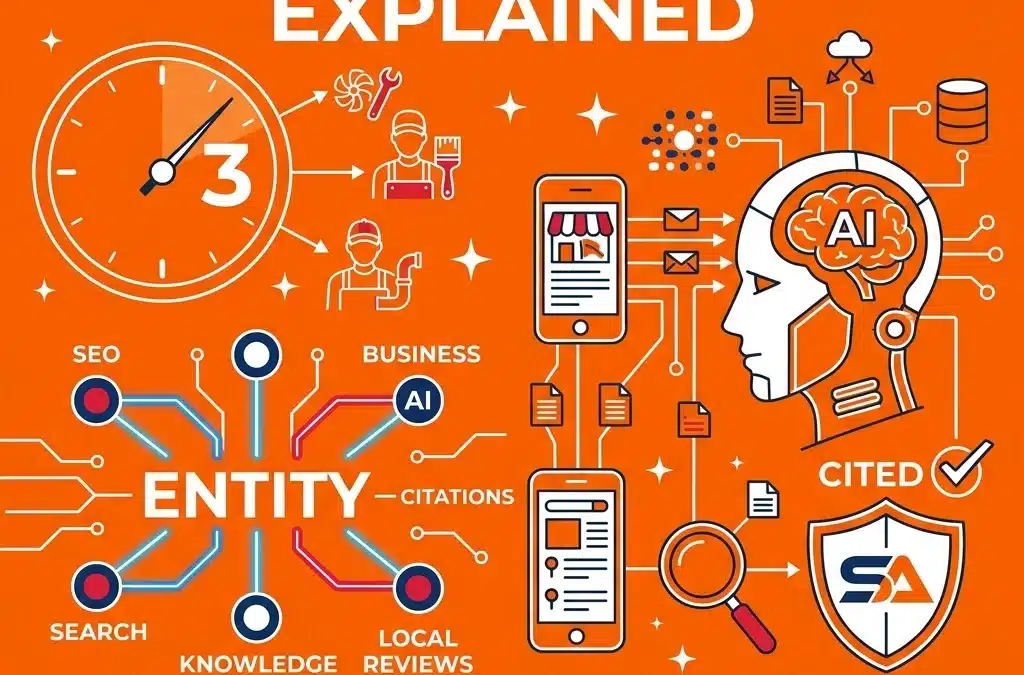
When an AI engine like Perplexity or Gemini answers a user's question, it doesn’t just browse the web in real-time like a human does. It relies on a "Knowledge Graph." This is essentially a massive map of how different entities relate to each other.
Imagine a constellation of stars. One star is "Plumbing." Another star is "Emergency Repairs." A third star is "Your Business Name."
Entity SEO is the process of drawing the lines between those stars. If the AI can see a strong, verified connection between "Your Business" and "Expert Plumbing in Fairfax," it will recommend you. If those lines are blurry or missing, the AI will ignore you, even if your website looks great.
This is why traditional SEO is failing many SMBs. You might rank for a keyword, but if the AI doesn't recognize you as a "Trusted Entity," you won't show up in the AI's generated response. To stay ahead, you need to understand where to use AI in your business to build these connections.
Why Keywords Aren’t Enough Anymore
Keywords are flat. Entities are multi-dimensional.
If you optimize for the keyword "affordable lawyer," you are competing with every other person who wrote those words on a page. If you optimize for the Entity of your law firm, you are providing the AI with data points:
Your physical location (verified via Google Maps and Apple Maps).
Your professional credentials (verified via state bar associations).
Your specific areas of expertise (verified via your content depth).
When the AI sees all these verified data points, it develops "confidence." High confidence leads to citations. When ChatGPT says, "According to several local sources, [Your Business] is the top-rated choice for this service," that is the modern equivalent of being #1 on Google.
The 3 Pillars of Getting Cited by AI
So, how do you actually do this? It sounds technical, but for a small business owner, it boils down to three main pillars that Web ABCs LLC focuses on for our clients.
1. Establishing Your "Entity Home"
Your website needs a "source of truth." This is usually your About page or your Homepage. It needs to clearly define who you are, what you do, and who you serve in a way that robots can digest. This isn't just about catchy marketing copy; it’s about structured data. We help businesses implement "Schema Markup": a hidden code that tells AI exactly what your business is.
2. Building Topical Authority
You can't just talk about one thing. To be an entity in the eyes of an AI, you need to own a "topic." If you are a landscaper, you should have content about soil types, seasonal planting, irrigation, and hardscaping. This shows the AI that your entity is a comprehensive authority on the subject. We often suggest using AI employees to help generate this volume of high-quality, authoritative content consistently.
3. Digital PR and Citations
AI engines look for "external confirmation." They check to see if other reputable entities (like local news sites, industry directories, or social media platforms) are talking about you. If the AI sees your business mentioned on a high-authority site, it strengthens the "node" in its knowledge graph.
How Web ABCs LLC Makes You the “AI Choice”
At Web ABCs LLC, we specialize in Marketing Technology that bridges the gap between old-school business and new-school AI. We don't just build websites; we build Entity foundations.
We know that as an SMB owner, you don’t have 40 hours a week to study semantic SEO or knowledge graph engineering. That’s where we come in. We use proprietary tools and AI-driven strategies to ensure your business isn't just a "string" of text on the web, but a recognized entity.
Our process involves:
Deep Schema Integration: We hardwire your site so AI agents can instantly categorize your services.
Local Entity Sync: We ensure your data is consistent across the entire web, which is a major ranking factor for local SEO in 2026.
Content Clustering: We help you build "Topical Maps" so that when an AI looks for an expert in your niche, your business is the only logical answer.
The Future of Search is Generative
We are moving toward a world where "searching" is replaced by "asking." People don't want a list of 10 blue links; they want an answer.
If you want your business to be the answer that Perplexity gives to a high-value lead, you have to stop thinking about keywords and start thinking about your Entity. The businesses that claim their spot in the AI knowledge graph today will be the ones that dominate their markets for the next decade.
Don't let your competitors get cited while you're still stuck on page 4 of the old search results. The transition to AI-driven search is the biggest opportunity for small businesses since the invention of the internet itself.
Ready to Claim Your Spot?
If all of this sounds like a lot, don't worry. You don't have to be a tech genius to win at Entity SEO: you just need the right partner.
At Web ABCs LLC, we take the complexity out of marketing technology. Whether you need help with your local SEO secrets or you're ready to integrate full AI agents into your workflow, we’re here to help you out-think and out-market the competition.
Stop being a keyword. Start being an Entity.
Give us a call at 703-864-2599 today to discuss how we can get your business cited and recommended by the AI engines of tomorrow. Let’s make sure when the AI is asked for a recommendation, your name is the first one it mentions.
Every small business owner knows the feeling of being pulled in a dozen different directions at once. You’re the CEO, the lead salesperson, the customer support rep, and sometimes even the person making sure the office coffee machine is refilled. While you're busy juggling these roles, profit is often leaking out of the bucket through missed phone calls, slow lead responses, and hours spent on manual data entry.
But what if I told you there’s a simple trick to plug those leaks and improve your profitability almost overnight? It doesn't involve hiring an expensive executive or investing six figures into a custom software build. The secret lies in small-scale AI agents.
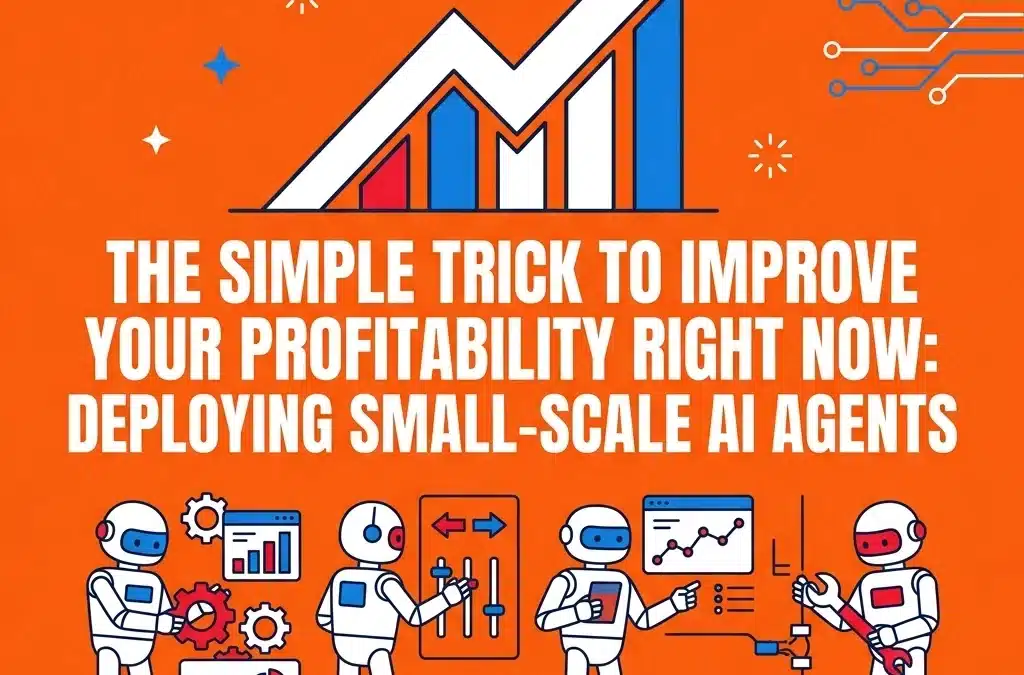
At Web ABCs LLC, we’ve seen firsthand how these "AI Employees" are transforming local businesses. By automating the repetitive, high-volume tasks that usually bog down a human team, you can scale your operations without the traditional overhead of a massive headcount.
What is a Small-Scale AI Agent?
Before we dive into the profitability aspect, let’s clear up the jargon. You’ve probably heard of AI chatbots, but small-scale AI agents are a different breed. While a basic chatbot follows a rigid script, an AI agent is designed to achieve a specific goal. Think of it as an "AI Employee" with a job description.
For example, an AI agent doesn't just say "Hello" to a website visitor. It qualifies the lead, checks your calendar for availability, and books an appointment: all without you lifting a finger. These agents are lightweight, targeted, and designed to work within the existing workflows of an SMB.
The "small-scale" part is crucial. You don't need a massive enterprise budget to deploy these tools. At Web ABCs LLC, we focus on helping businesses implement AI solutions that deliver a fast return on investment. According to industry data, well-implemented AI solutions often achieve full cost recovery within 6 to 14 months. For a small business, that kind of ROI is a game-changer.
The Profitability Trick: Why Speed is Everything
In 2026, the biggest threat to your profitability isn't your competition; it’s your response time. Research consistently shows that businesses that respond to a lead within five minutes are significantly more likely to close the deal than those that wait even thirty minutes.
Unfortunately, most small business owners can't sit by their phones or computers 24/7. This is where the profitability leak occurs. When a potential customer reaches out and gets a voicemail or a generic "we'll get back to you" email, they’ve already moved on to the next person on Google.
By deploying an AI agent, you ensure a 100% response rate. Whether it’s 2:00 PM on a Tuesday or 2:00 AM on a Sunday, your AI Employee is there to engage the prospect. This "speed to lead" capability directly impacts your bottom line by converting traffic you’re already paying for into actual customers. You can read more about how this works in our guide on how AI chatbots out-sell the competition.
Scaling Without the Headcount
The traditional way to grow a business is to hire more people. But hiring is expensive, risky, and time-consuming. Between salaries, benefits, training, and management, the "cost" of a new employee is often much higher than their base pay.
Small-scale AI agents allow you to scale without the headcount. An AI agent can handle the workload of two or three administrative assistants when it comes to scheduling, data entry, and basic customer inquiries.
By offloading these tasks to AI, your human team can focus on "High-Value Tasks": the things that actually require human empathy, complex problem-solving, and relationship-building. This shift doesn't just save money; it makes your existing team more productive and satisfied in their roles. No one likes spending four hours a day answering the same five questions over email.
Meet Your New “AI Employees”
We often recommend that SMBs start with a few key AI roles. These aren't just pieces of software; they are functional members of your team:
The Gatekeeper: This agent lives on your website or social media. It filters out spam, answers common FAQs, and passes high-quality leads directly to your sales team.
The Appointment Setter: No more back-and-forth emails trying to find a time that works. This agent integrates with your calendar and handles the entire booking process.
The Review Gatherer: We know that Google reviews matter immensely in 2026. An AI agent can follow up with customers after a purchase to request a review, boosting your local SEO automatically.
The 24/7 Support Desk: This agent handles common troubleshooting issues, allowing your customers to get help instantly rather than waiting for business hours.
Deploying these agents is the "simple trick" because they work in the background, constantly optimizing your business operations while you focus on the big picture.
Overcoming the Cost Barrier
Many SMB owners shy away from AI because they assume it’s too expensive. They see headlines about multi-million dollar AI investments from companies like Google or Amazon and think, "That’s not for me."
The reality is that small-scale AI is incredibly affordable. At Web ABCs LLC, we offer packages designed specifically for the SMB budget. Whether you need a simple lead-capture agent or a more advanced multi-channel ecosystem, there is a solution that fits your needs.
When you compare the monthly cost of an AI agent: which is often less than a single utility bill: to the cost of a missed $1,000 contract, the math becomes very simple. You aren't spending money; you are buying back your time and securing your revenue.
Common Pitfalls to Avoid
While deploying AI is a "simple" trick, it’s not a "set it and forget it" magic wand. Many businesses make the mistake of over-complicating their AI or using tools that don't talk to their existing software.
One of the biggest mistakes is failing to define what the AI agent is actually supposed to do. If you try to make one agent do everything, it will end up doing nothing well. Start small. Pick one bottleneck in your business: like missed calls or slow email replies: and deploy an agent to solve that specific problem.
We’ve compiled a list of the 5 common mistakes small businesses make with AI to help you avoid the most frequent hurdles. The goal is to make your business more efficient, not to add another layer of tech stress.
The Future of the SMB Workforce
By 2027, the gap between businesses that use AI and those that don't will be a chasm. The businesses that thrive will be those that embrace the "Hybrid Workforce": a team where humans and AI agents work side-by-side.
This isn't about replacing people; it's about empowering them. When your "AI Employee" handles the grunt work, your human employees can provide better service, think more creatively, and help you grow the business. This is how you reclaim your time and move from being a "solopreneur" or a stressed-out owner to a true AI-powered CEO.
How to Get Started Today
Improving your profitability doesn't require a radical overhaul of your business model. It just requires a smarter way of handling the tasks you're already doing.
If you’re ready to see how small-scale AI agents can transform your business, Web ABCs LLC is here to help. We specialize in creating custom AI solutions that fit the unique needs of small business owners. We don't just give you the tools; we help you integrate them so they actually work for you.
Don't let another lead slip through the cracks. Reach out to us today to discuss how we can deploy your first "AI Employee."
Give us a call at 703-864-2599 or visit our website at webabcs.com to book a consultation. Let’s start boosting your profitability together.
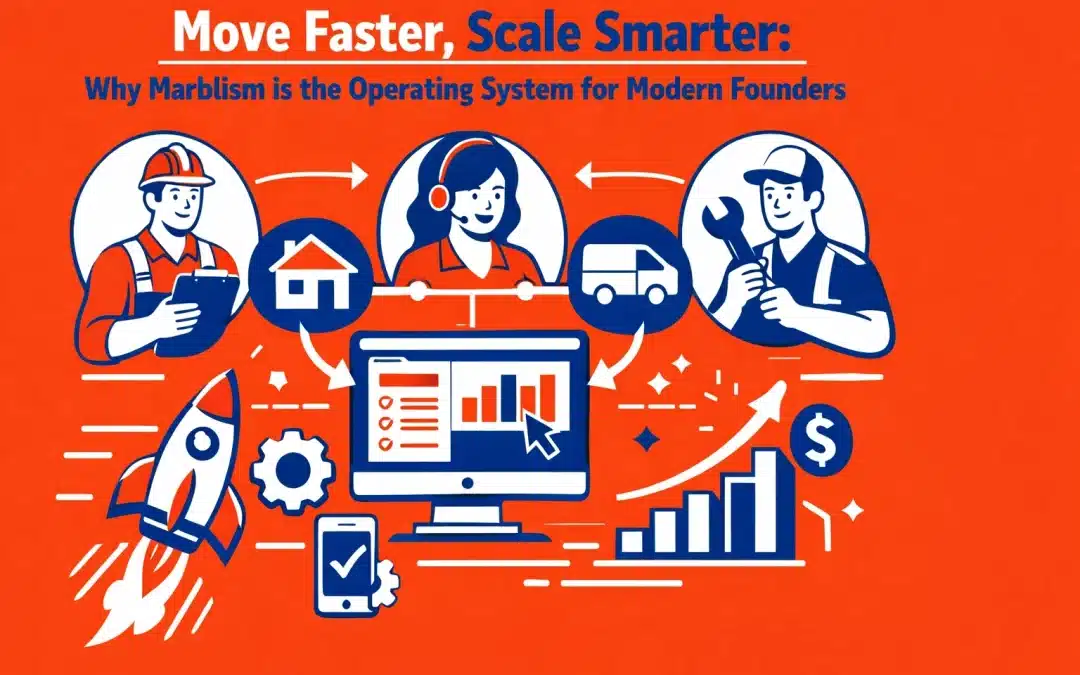
Move Faster, Scale Smarter: Why Marblism is the Operating System for Modern Founders
In the rapidly evolving landscape of 2026, the traditional roadmap for launching a startup has become obsolete. The days of spending six months hiring a full-stack engineering team, raising a seed round based on a wireframe, and laboring over thousands of lines of manual code are behind us. Today, the most successful founders aren't just building products; they are orchestrating systems. At Web ABCs LLC, we’ve seen a shift in how marketing technology is built and deployed, and at the heart of this revolution is Marblism: the platform we believe serves as the "operating system" for the modern, AI-driven founder.
The Shift from Hiring to Deploying
For decades, the biggest bottleneck for any founder was the "technical gap." If you weren't a coder, you had to find a technical co-founder. If you didn't have capital, you had to sweat equity your way to a Minimum Viable Product (MVP). Marblism has fundamentally changed this dynamic by introducing the concept of "prompt-to-app" development. It allows founders to move from an idea to a fully functional, full-stack application using natural language prompts.
Think of it as the transition from manual assembly lines to automated robotics. In the past, every piece of software was a custom build. With Marblism, founders are deploying an AI-driven infrastructure that handles the heavy lifting of front-end and back-end architecture. This isn't just about making coding easier; it’s about making the entire concept of a "Day-One Team" redundant. You no longer need a room full of developers to get off the ground; you need a clear vision and the right operating system to execute it.
Why Marblism is the "Operating System" for Success
An operating system’s job is to manage resources, provide a platform for applications to run, and ensure that different components of a system communicate effectively. Marblism does exactly this for a startup. By automating roughly 90% of the code generation process, it acts as the underlying layer that manages the complexities of modern software development.
1. 10x Productivity and Speed
Speed is the only real competitive moat a startup has. Larger corporations have more money, more data, and more users, but they are slow. Marblism enables founders to be roughly 10 times more productive than traditional development teams. When you can iterate on a feature in hours rather than weeks, you can find product-market fit faster. This speed is what allows lean teams to outmaneuver giants. Visit our AI services page to see how we integrate these rapid cycles into our broader marketing technology strategies.
2. Reducing the Cost of Failure
In the old world, a failed product meant hundreds of thousands of dollars in lost development costs. Marblism lowers the barrier to entry so significantly that the "cost of failure" is nearly zeroed out. This encourages a culture of experimentation. Founders can test three different app concepts in the time it used to take to write a single spec document. If one doesn't work, you simply pivot the prompt and rebuild. This agility is why we recommend Marblism as the foundational tool for any new project.
Building Lean, AI-Driven Operations
Modern founders are increasingly moving toward the "one-person unicorn" model. This is only possible when you replace traditional headcount with AI-driven operations. Marblism provides "AI employees who love overtime": software agents and automated codebases that work 24/7 without the overhead of benefits, office space, or management layers.
This lean approach isn't just about saving money; it’s about focus. When a founder isn't bogged down in managing a large technical team or debugging legacy code, they can focus on what actually moves the needle: customer acquisition, brand strategy, and high-level vision. At Web ABCs LLC, we specialize in helping businesses transition to these lean, AI-powered models to stay competitive in a crowded market.
Leveraging Proven Operator Expertise
One of the reasons Marblism is so effective is that it wasn't built in a vacuum. Its founders, Ulric Musset and Cyril Pluche, are proven operators who previously built and exited Vauban, a fintech giant. They understand the pain points of scaling a business to millions in revenue. They built Marblism to be the tool they wish they had when they were starting out. This "founder-for-founders" mentality is baked into the platform’s DNA, ensuring that every feature is designed to solve real-world operational challenges.
How Marblism Fits into Your Growth Strategy
Integrating Marblism into your business isn't just a technical decision; it's a strategic one. To truly "scale smarter," you need to look at your entire marketing and operational stack. Here is how we recommend founders utilize the Marblism OS alongside Web ABCs services:
Rapid Prototyping: Use Marblism to build the core product. Use our free audit to identify the gaps in your current digital presence.
Marketing Integration: Once your app is live, connect it with high-converting marketing materials. You can find resources for this at our marketing materials hub.
Continuous Iteration: Don't just launch and leave. Use Marblism to constantly update your software based on real-time user feedback.
The goal is to create a seamless loop where product development and marketing are happening in tandem, powered by AI. This level of synchronization was impossible just a few years ago. Now, it is the standard for any founder who wants to survive and thrive.
The Future is Built on Prompts
As we look toward the rest of 2026, the gap between those who use AI "operating systems" and those who rely on traditional methods will only widen. Marblism isn't just a trend; it represents a fundamental shift in how value is created in the digital age. By abstracting the complexity of code, Marblism empowers the most important part of any business: the founder's imagination.
If you are ready to stop moving at the speed of human hiring and start moving at the speed of AI, it’s time to rethink your infrastructure. Whether you are building a new SaaS platform, a marketplace, or an internal tool to streamline your operations, Marblism provides the framework to do it faster, cheaper, and more reliably than ever before.
Ready to Scale?
At Web ABCs LLC, we are committed to helping modern founders navigate this new frontier. We don't just provide tools; we provide the strategic roadmap to ensure those tools drive revenue and growth. If you're looking to integrate Marblism into your workflow or want to see how AI-driven operations can transform your business, we’re here to help.
Don't let technical hurdles hold back your next big idea. Contact us today at 703-864-2599 to discuss your vision, or book a session directly on our consultation calendar. You can also explore our blog for more insights on the latest in marketing technology and AI innovation.
The future of entrepreneurship is lean, it is fast, and it is powered by Marblism. It’s time to upgrade your operating system.