by George Stark | Dec 23, 2025 | AI
AI is everywhere these days, and if you're running a plumbing, HVAC, electrical, or any other home service business, you've probably heard you need to jump on the AI bandwagon. But here's the thing – most home service business owners are making critical mistakes that are costing them customers and money.
Don't worry though. We're going to walk through the seven biggest AI marketing mistakes we see every day, and more importantly, how to fix them so you can actually grow your business.
Mistake #1: Using AI Without Clean Customer Data
This is the big one. You can't feed garbage into AI and expect gold to come out.
Most home service businesses have customer information scattered everywhere – sticky notes, old spreadsheets, different software systems that don't talk to each other. When you try to use AI marketing tools with this messy data, you get messy results.
What happens: Your AI sends the wrong messages to the wrong people. You might target someone for furnace repair who just had their system replaced last month, or send plumbing ads to commercial clients when you only do residential work.
The fix: Clean up your customer database first. Merge duplicate entries, update old contact information, and make sure you're tracking important details like service history, property type, and preferred contact methods. Most good CRM systems can help you clean this up automatically.

Mistake #2: Over-Automating Customer Interactions
AI chatbots and automated responses seem like a great idea until they start frustrating your customers.
When someone's dealing with a burst pipe or a broken air conditioner, they want to talk to a real person who can understand their emergency and get help on the way fast. Nothing kills trust faster than a chatbot that can't understand "my basement is flooding" and keeps asking them to select from a menu.
What happens: You lose emergency calls to competitors who answer their phones with real people. Customers get frustrated and leave bad reviews about your "unhelpful" automated system.
The fix: Use AI to assist your team, not replace them. Set up AI to handle simple questions like "What are your hours?" or "Do you service my area?" but make sure there's always an easy way to reach a real person for urgent issues.
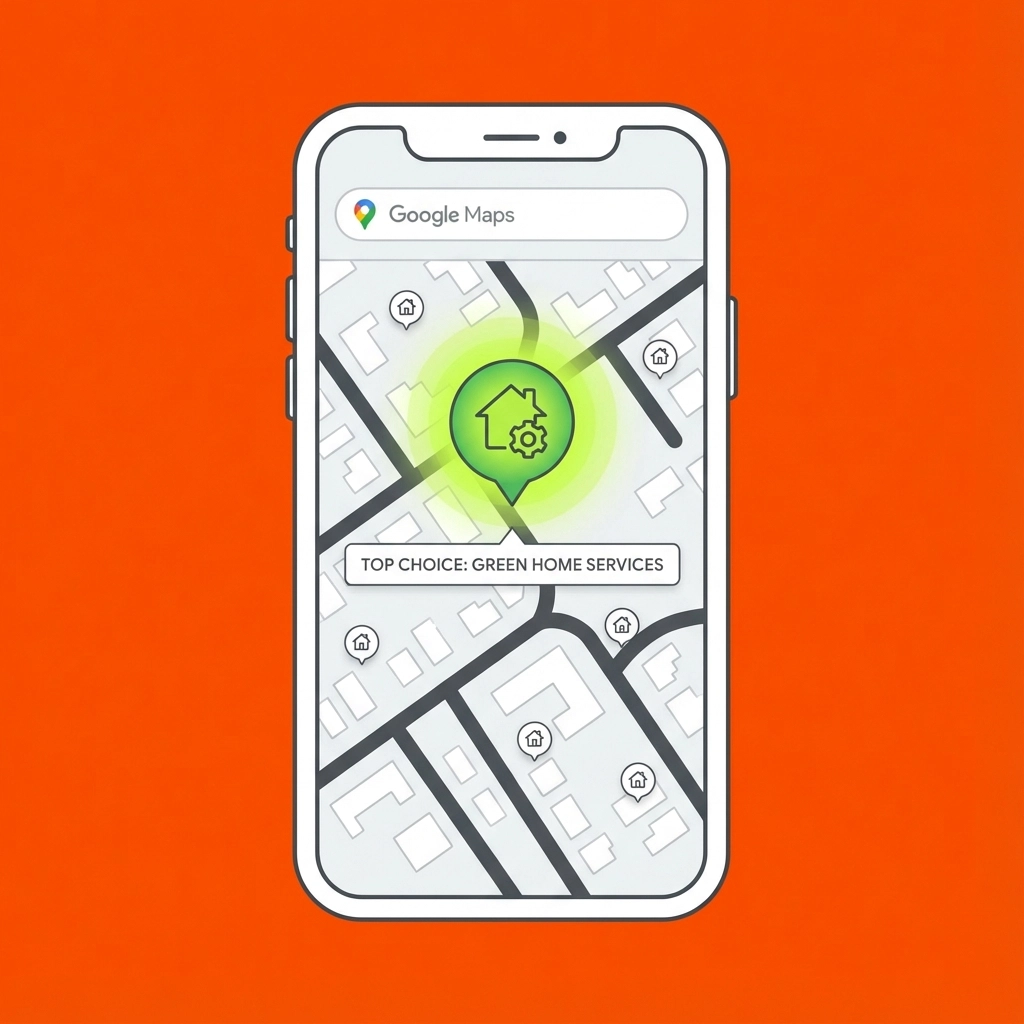
Mistake #3: Ignoring Google Maps and Local SEO
Here's a shocking fact: 97% of people learn more about a local business online than anywhere else. Yet many home service businesses are using AI for fancy social media campaigns while completely ignoring their Google Maps presence.
Your Google My Business profile is often the first thing potential customers see. If it's not optimized, all the AI marketing in the world won't help you.
What happens: Customers can't find you when they search for "plumber near me" or "emergency HVAC repair." They end up calling your competitors instead.
The fix: Use AI tools to help monitor and respond to reviews quickly, but make sure you're consistently updating your business hours, services, and photos. Ask satisfied customers to leave reviews, and always respond professionally to negative ones.
Mistake #4: Poor Targeting and Personalization
Generic marketing messages don't work anymore. People expect personalized communication, especially when they're spending thousands of dollars on home repairs or installations.
Many home service businesses use AI to blast the same message to everyone on their list. A homeowner dealing with a furnace breakdown in winter needs a different message than someone casually shopping for a bathroom renovation in spring.
What happens: Your marketing feels spammy and irrelevant. Potential customers ignore your messages or unsubscribe completely.
The fix: Segment your customer list based on service type, season, and past interactions. Use AI to automatically send targeted messages – heating system maintenance reminders before winter, AC tune-up offers before summer, and emergency service promotions during peak seasons.
Mistake #5: Not Tracking Lead Sources and Conversions
This mistake costs home service businesses thousands of dollars every month. You're spending money on AI-powered ads and marketing campaigns, but you have no idea which ones actually bring in paying customers.
Maybe your Facebook ads are generating lots of clicks but no actual service calls. Or your Google Ads are bringing in plenty of leads, but they're all people outside your service area or looking for services you don't provide.
What happens: You keep throwing money at marketing that doesn't work while missing opportunities to invest more in what does work.
The fix: Set up proper call tracking and conversion monitoring. Use unique phone numbers for different campaigns so you know exactly which marketing efforts are bringing in real customers. AI can help analyze this data and automatically adjust your ad spending to focus on what works best.
Mistake #6: Failing to Train Your Team on AI Tools
You've invested in AI marketing tools, but your team doesn't know how to use them effectively. Your office manager is scared of the new chatbot system, your technicians don't understand how the automated scheduling works, and nobody knows how to interpret the AI-generated reports.
What happens: You're paying for expensive AI tools that sit unused, or worse, are used incorrectly and create more problems than they solve.
The fix: Invest time in proper training. Make sure everyone on your team understands how the AI tools work and how they fit into your overall business process. Start with simple tools and gradually add more complex AI features as your team gets comfortable.
Mistake #7: Setting Unrealistic Expectations
AI isn't magic. It won't instantly transform your struggling home service business into a goldmine overnight. Many business owners expect AI to solve all their marketing problems immediately, then get frustrated when they don't see instant results.
AI marketing tools work best when they're part of a solid overall strategy that includes good customer service, quality work, fair pricing, and consistent follow-up.
What happens: You get disappointed with AI results and abandon tools that could actually help your business grow with the right expectations and patience.
The fix: Think of AI as a powerful assistant, not a replacement for good business fundamentals. Use AI to help you work more efficiently, reach more potential customers, and provide better service – but remember that the quality of your actual work is still the most important factor in your success.
Getting AI Marketing Right for Your Home Service Business
The good news is that when done correctly, AI marketing can be incredibly powerful for home service businesses. It can help you:
- Respond to leads faster (studies show you're 7 times more likely to qualify a lead if you respond within an hour)
- Target the right customers at the right time (like promoting heating services just before cold weather hits)
- Automate routine tasks so you can focus on actually serving customers
- Track what marketing actually works so you stop wasting money
The key is starting simple and building up gradually. Don't try to implement every AI tool at once. Pick one area – maybe lead tracking or review management – and get that working well before moving on to the next.
Remember, your customers care about one thing: getting their problems solved quickly and professionally. Use AI to help you do that better, not to replace the personal touch that sets great home service businesses apart from the competition.
Ready to Fix Your AI Marketing Strategy?
If you're tired of making these expensive mistakes and want to see how AI can actually help grow your home service business, we're here to help. Our team specializes in helping plumbers, HVAC contractors, electricians, and other home service professionals use AI marketing tools effectively.
Call us at 703-864-2599 today for a free consultation. We'll review your current marketing efforts, identify which AI tools make sense for your specific business, and create a plan that actually brings in more qualified customers.
Don't let another month go by throwing money at marketing that doesn't work. Let's get your AI marketing strategy fixed and start growing your business the right way.
Keywords for metadata: AI marketing mistakes, home service marketing, plumber marketing AI, HVAC marketing automation, electrician lead generation, local service business AI, Google My Business optimization, home service lead tracking, AI chatbots for contractors, automated marketing for home services, customer data management, AI marketing strategy, home service advertising
by George Stark | Dec 19, 2025 | AI
Ready to level the playing field? Contact webABCs at (703) 864-2599 for your AI strategy consultation.
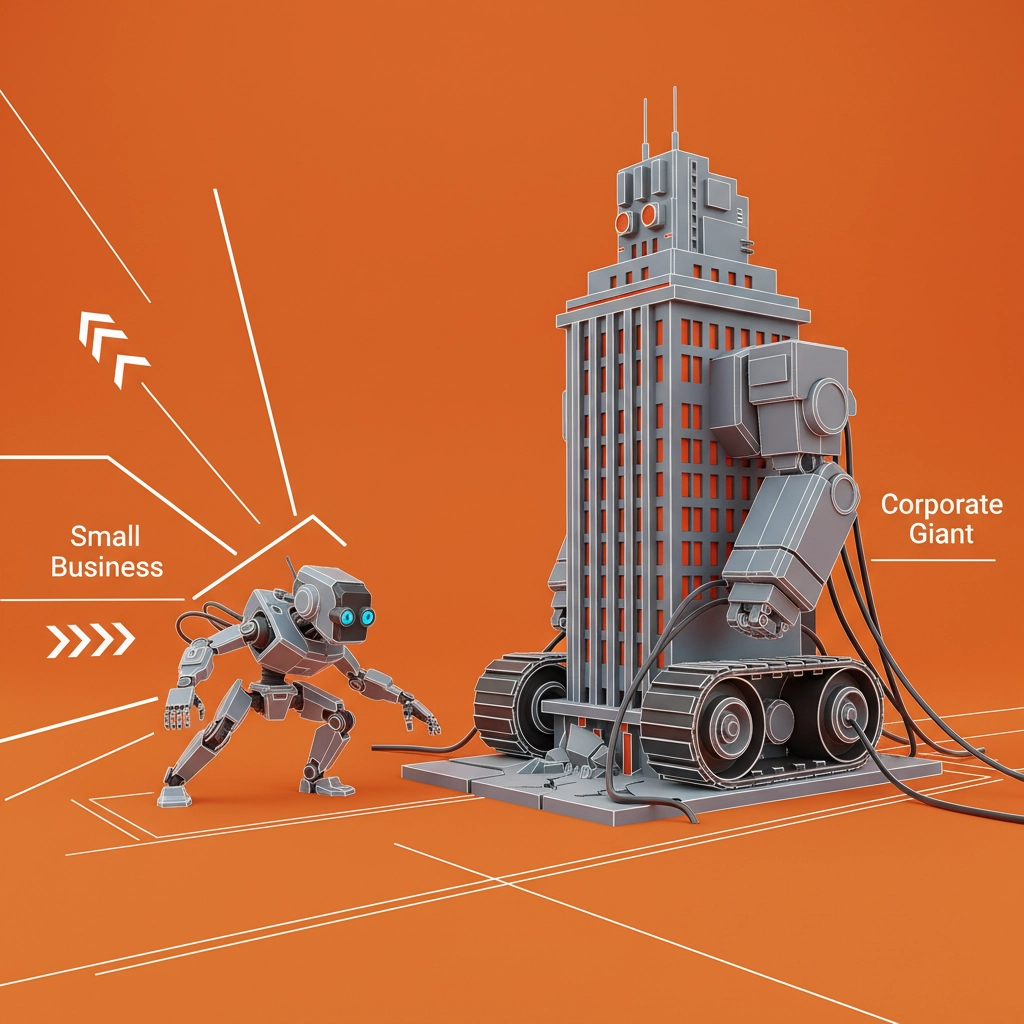
You’re tired of watching big corporations dominate your market with seemingly unlimited resources while you’re stuck fighting for scraps. Every day, you see Amazon, Walmart, and other giants crushing smaller players with their massive teams, deep pockets, and sophisticated technology. But here’s what might surprise you: 2026 is shaping up to be the year that David finally gets a real shot at Goliath, and artificial intelligence is the slingshot.
The playing field isn’t just leveling; it’s actually tilting in your favor. While corporate giants are drowning in bureaucracy and legacy systems, you have something they desperately wish they could recapture: agility.
The AI Revolution Is Already Here (And You’re Not Too Late)
Forget everything you think you know about AI being only for tech companies with million-dollar budgets. The landscape has completely transformed. Right now, over 90% of small businesses are already using at least one AI tool, a massive jump from just 60% who weren’t using any AI previously.
This isn’t some distant future scenario. Your competitors down the street are probably already leveraging AI to automate their customer service, optimize their marketing campaigns, and streamline their operations. The question isn’t whether AI will impact your industry, it’s whether you’ll be leading the charge or playing catch-up.
Why Small Businesses Are Actually Winning the AI Race
Here’s where it gets interesting: small businesses are reporting results that would make Fortune 500 CEOs jealous. Companies using AI are seeing 85% increased sales, 84% profit growth, and 82% increased productivity. These aren’t marginal improvements, we’re talking about business transformation that happens in months, not years.
The return on investment? For every dollar you spend on AI solutions, you’re looking at approximately $3.50 to $4.00 back in your pocket. When was the last time you saw an investment opportunity with that kind of immediate payback?
But here’s the real kicker: 58% of small businesses using AI are saving over 20 hours per month, while 66% are cutting costs by $500 to $2,000 monthly. That’s not just efficiency, that’s found money that goes straight to your bottom line.
The Corporate Disadvantage (Yes, It’s Real)
While you’re reading this and potentially making decisions about AI implementation this week, your giant competitors are stuck in committee meetings. Large corporations have to navigate:
- Legacy system integration nightmares that take months to resolve
- Approval processes that require sign-offs from multiple departments
- Risk-averse cultures where innovation moves at a snail’s pace
- Complex hierarchies that slow down decision-making
Only 57% of business units at large companies report being ready to adopt new AI applications. Think about that: nearly half of big business divisions are essentially paralyzed by their own size and complexity.
You, on the other hand, can test an AI chatbot this afternoon, implement automated email marketing by next week, and have predictive analytics running by month’s end. Speed matters, and you’ve got it in spades.
Where Smart Small Businesses Are Making Their Move
The most successful small businesses aren’t trying to compete on every front: they’re getting surgical with their AI implementation. Here’s where you should focus your efforts:
Data Analysis (62% of small businesses are already here): You’re swimming in customer data, but you probably don’t have a full-time analyst to make sense of it all. AI can spot patterns in your sales data, customer behavior, and market trends that would take a human analyst weeks to uncover.
Content Generation (55% are using this): Whether it’s social media posts, product descriptions, or email campaigns, AI can help you maintain a consistent content pipeline without hiring an entire marketing team.
Customer Engagement (46% have implemented this): AI chatbots and virtual assistants can handle routine customer inquiries 24/7, letting you focus on high-value interactions while never missing a potential sale.
The Workforce Multiplication Effect
Here’s something that might surprise you: more than 80% of small businesses using AI report that it’s actually helped them expand their workforce, not shrink it. Instead of replacing employees, smart business owners are using AI to multiply their team’s capabilities.
Think of it this way: when your customer service rep isn’t spending three hours a day answering “What are your hours?” and “Where are you located?”, they can focus on solving complex problems and building relationships. When your marketing person isn’t manually scheduling social media posts, they can develop creative campaigns that drive real results.
Real-World Applications That Drive Results
Let’s get specific about what this looks like in practice. One small e-commerce business implemented AI-driven personalization and achieved conversion rates 3x the industry average with a 4x increase in customer lifetime value. They didn’t have a team of data scientists: they used accessible AI tools to deliver Amazon-level personalization.
Another local service business started using AI for predictive maintenance scheduling, reducing their emergency calls by 40% while increasing customer satisfaction scores. Their secret? They could predict problems before customers even knew they had them.
40% of small businesses are already using generative AI for marketing, content creation, and customer service. These aren’t experimental side projects: they’re core business functions driving real revenue.
The 2026 Tipping Point
Why is 2026 the magic year? Several factors are converging:
Technology Maturity: AI tools have moved beyond the experimental phase. They’re reliable, affordable, and user-friendly enough for non-technical business owners to implement successfully.
Market Recognition: 78% of small business owners now believe AI is necessary to compete: not helpful, but necessary. This represents a fundamental shift in business thinking.
Economic Pressure: With inflation, labor costs, and supply chain challenges continuing, businesses need efficiency gains to maintain profitability. AI provides those gains at a scale that was impossible just two years ago.
Competitive Advantage Window: Early adopters are still capturing significant market advantages. But this window is closing fast as AI adoption becomes mainstream.
Overcoming the Common Objections
“It’s too expensive.” The barrier to entry has never been lower. Many AI tools offer free tiers or monthly subscriptions under $100. Compare that to hiring another employee at $40,000+ annually.
“It’s too complicated.” Today’s AI tools are designed for business owners, not programmers. If you can use a smartphone, you can implement business AI.
“My customers won’t like it.” Your customers want faster service, better experiences, and personalized attention. AI helps you deliver all three.
“I don’t have time to learn.” The businesses that don’t make time for AI implementation in 2026 will be making time to figure out why they’re losing market share in 2027.
Your Next Steps (Because Waiting Isn’t a Strategy)
The global AI-enabled business market is projected to deliver $140–160 billion in revenue by 2026, and small businesses are capturing an increasingly large share of that pie. Every month you wait is a month your competitors are gaining ground.
Start with one area: maybe customer service automation or content generation. Get comfortable with the technology, measure the results, then expand. The key is starting now while the competitive advantage is still available.
Your giant competitors are still in planning meetings while you could be implementing solutions this week. Their bureaucracy is your opportunity. Their slow decision-making process is your competitive advantage.
The Bottom Line
2026 isn’t just another year: it’s the inflection point where small business agility trumps corporate resources. The tools are available, the results are proven, and the window of opportunity is wide open.
The question isn’t whether AI will transform your industry. It’s whether you’ll be leading that transformation or scrambling to catch up. The giants are coming, but they’re moving slowly. You have the speed advantage: use it.
Ready to turn your small business into a giant-killer? Contact webABCs at 703 864-2599 or visit our AI consultation page to discover how AI can transform your business in 2026. Don’t wait until your competitors have already captured your market share.
by George Stark | Dec 19, 2025 | AI
Ready to make smarter hiring decisions? Call us at (703) 864-2599 for a free consultation on AI solutions for your business.
You’re staring at another stack of resumes, wondering if you should hire that new customer service rep or if there’s a better way. Meanwhile, your current team is drowning in repetitive tasks, and you’re bleeding money on overtime just to keep up with basic operations.
Here’s the thing: the choice between AI agents and human employees isn’t really a choice anymore: it’s about finding the right mix. Smart small business owners in 2025 are discovering that combining both strategically can slash costs by up to 70% while actually improving service quality.
Let’s break down exactly when you should choose AI, when you need humans, and how to blend both for maximum impact.
What Exactly Are AI Agents?
Think of AI agents as digital employees that never sleep, never call in sick, and work for about $2 per hour instead of $25. They’re software programs that can handle conversations, process orders, manage schedules, and complete routine tasks just like a human would: but faster and more consistently.
Unlike basic chatbots that spit out canned responses, modern AI agents can actually think through problems, access your systems, and make decisions. They can check inventory, process refunds, schedule appointments, and even handle complex customer complaints by following decision trees you set up.
The Case for AI Agents: When Robots Win
Cost Savings That’ll Shock You
The numbers don’t lie. A full-time customer service employee costs you roughly $50,000 annually when you factor in salary, benefits, taxes, and training. An AI agent handling the same workload? About $2,000 per year. That’s a 96% cost reduction.
Sarah from Atlanta learned this the hard way. Her boutique marketing agency was spending $120,000 annually on two customer service reps who mostly answered the same 20 questions over and over. After implementing AI agents, she cut those costs to $15,000 while improving response times from 4 hours to 4 minutes.
24/7 Availability Without Overtime
Your customers don’t stop having problems at 5 PM. AI agents work around the clock, handling late-night order issues, weekend inquiries, and holiday emergencies without charging you a penny extra. No more losing sales because someone called after hours.
Perfect Consistency Every Time
Human employees have bad days. They get tired, cranky, or distracted. AI agents deliver the exact same quality interaction whether it’s their first customer of the day or their thousandth. They follow your scripts perfectly, never forget to ask for reviews, and always upsell when appropriate.
Instant Scalability
Black Friday traffic spike? No problem. An AI agent can handle 1,000 simultaneous conversations as easily as 10. Try doing that with human staff without bankrupting yourself on temporary hiring and training.
When You Still Need Humans: The Irreplaceable Elements
Complex Problem-Solving and Creativity
When Mrs. Johnson calls because her custom wedding cake order got mixed up three days before her daughter’s wedding, you need human empathy, creative solutions, and the ability to think outside the box. AI agents excel at routine tasks but struggle with unique situations requiring judgment calls.
Building Real Relationships
People buy from people they trust. Your top salesperson who remembers that John’s daughter just started college and asks about it during calls? That relationship-building creates customer loyalty that no AI can replicate.
Strategic Decision Making
AI agents can tell you what happened, but they can’t decide what you should do about it. Strategic planning, market analysis, and business development still require human intelligence and experience.
The Real-World Comparison: AI vs Human Performance
Let’s look at actual performance metrics from small businesses that track both:
Speed and Efficiency:
- AI agents respond in under 30 seconds, humans average 3-5 minutes
- AI handles 85% of routine inquiries without escalation
- Processing time for standard requests: AI completes in 2 minutes, humans need 8-12 minutes
Cost Breakdown (Annual):
- AI Agent: $2,000 (software) + $3,000 (setup/training) = $5,000 total
- Human Employee: $35,000 (salary) + $15,000 (benefits/taxes) + $5,000 (training/equipment) = $55,000 total
Quality Metrics:
- AI consistency rating: 98% (same quality every interaction)
- Human satisfaction for complex issues: 89% (when properly escalated)
- Customer preference: 67% prefer AI for simple tasks, 78% prefer humans for complex issues
The Winning Strategy: Hybrid Teams
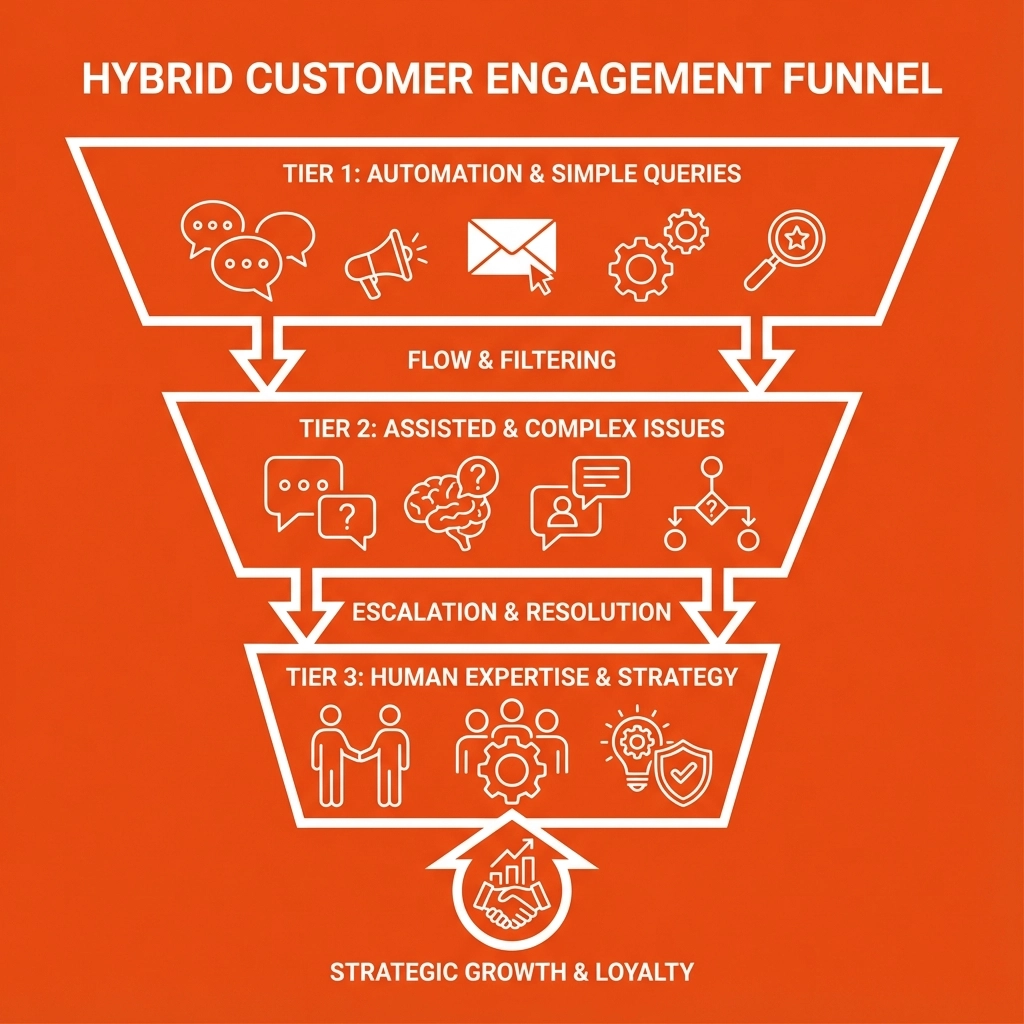
The most successful small businesses use a tiered approach:
Tier 1: AI Handles the Basics (80% of inquiries)
- Order status checks
- Basic product questions
- Appointment scheduling
- Password resets
- Simple troubleshooting
Tier 2: Smooth Human Handoffs (15% of inquiries)
- Complex technical issues
- Complaints requiring empathy
- Custom orders or special requests
- Billing disputes
Tier 3: Human Expertise (5% of inquiries)
- Strategic account management
- Major problem resolution
- Sales negotiations
- Relationship building
How to Decide What’s Right for Your Business
Choose AI Agents First If:
- You’re handling high volumes of repetitive inquiries
- Your team spends more than 30% of their time on routine tasks
- You need 24/7 coverage but can’t afford night shifts
- Cash flow is tight and you need immediate cost savings
- Your customers mostly need quick, straightforward answers
Stick with Humans If:
- Your business depends heavily on personal relationships
- You handle mostly unique, complex situations
- Regulatory compliance requires human oversight
- Your competitive advantage comes from personalized service
- You’re in a creative or strategic industry
Go Hybrid When:
- You want the best of both worlds (which is usually the answer)
- Your business has both routine and complex needs
- You want to free up human talent for higher-value work
- You’re growth-focused and need scalable solutions
Real Success Stories from Small Businesses
Mike’s HVAC Company (Phoenix, AZ):
Mike was drowning in service calls and couldn’t afford another full-time dispatcher. He implemented an AI agent for appointment scheduling and basic troubleshooting. Result: 40% reduction in phone time for his human staff, 24/7 emergency scheduling, and $45,000 annual savings.
Jennifer’s E-commerce Store:
Jennifer’s online pet supply business was losing customers due to slow response times. Her AI agent now handles order tracking, return processing, and basic product questions, while her human team focuses on complex customer relationships. Customer satisfaction increased 25% while support costs dropped 60%.
Getting Started: Your Action Plan
Week 1: Audit Your Current Workload
Track what your team spends time on for one week. Identify repetitive tasks that follow predictable patterns: these are perfect AI candidates.
Week 2: Start Small
Pick one routine function like appointment scheduling or FAQ responses. Test with an AI agent while keeping human backup available.
Week 3: Monitor and Adjust
Watch customer satisfaction scores and employee feedback. Fine-tune the AI’s responses and handoff procedures.
Month 2+: Expand Gradually
Add more functions as you get comfortable. Always maintain the human safety net for complex issues.
The bottom line? You don’t have to choose sides in the AI vs human debate. The smartest small business owners are building hybrid teams that leverage both AI efficiency and human expertise. Start with AI for your routine tasks, keep humans for relationship building and complex problem-solving, and watch your costs drop while service quality soars.
Ready to explore AI solutions for your business? Call (555) 123-4567 or schedule a free consultation to discover which tasks in your business are perfect AI candidates. Let’s build your hybrid team strategy together.